Every few weeks, a new tool promises to fix business growth.
A new CRM.
A smarter AI assistant.
A faster analytics dashboard.
A “done-for-you” marketing platform.
Businesses buy them with hope.
And then… nothing really changes.
Revenue stays flat.
Leads remain unqualified.
Teams feel busy—but not effective.
The problem isn’t a lack of tools.
It’s a lack of clear thinking.
The Tool Obsession Problem
Modern businesses are drowning in software.
Marketing teams juggle:
- CRM systems
- Ad platforms
- Email automation tools
- Analytics dashboards
- Project management software
Each tool solves a small, isolated problem.
But when there’s no clear strategy behind them, tools don’t create clarity—they create noise.
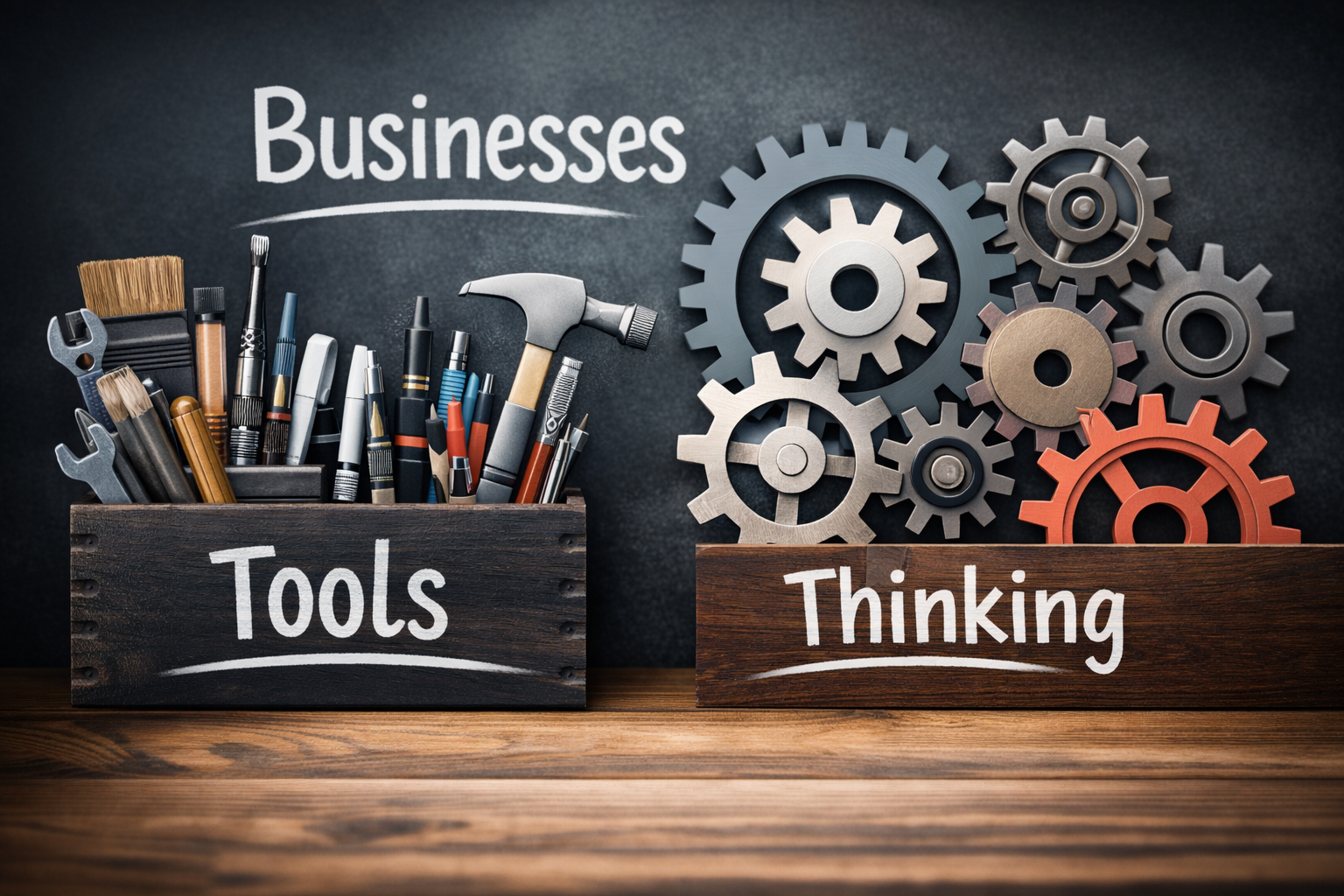
Tools are amplifiers.
They magnify what already exists.
If your thinking is unclear, tools will only help you move faster in the wrong direction.
Why Tools Feel Productive (But Often Aren’t)
Tools create the illusion of progress.
- Dashboards look impressive
- Reports feel sophisticated
- Automation gives a sense of scale
But none of these answer the most important questions:
- Who exactly are we targeting?
- What problem are we solving better than others?
- Why should a customer choose us?
- What action do we want prospects to take next?
Without answers to these, tools become expensive distractions.
Better Thinking Always Comes Before Better Tools
High-performing businesses don’t start with software.
They start with decisions.
Clear thinking means:
- Choosing focus over volume
- Saying no to distractions
- Designing systems, not hacks
- Prioritizing leverage over activity
When thinking is sharp, tools become simple enablers, not magic solutions.
The Real Bottleneck in Most Businesses
After working with multiple growing companies, one pattern is consistent:
The biggest bottleneck is not marketing, sales, or technology.
It’s decision-making.
Teams often struggle with:
- Conflicting priorities
- Unclear ownership
- Short-term tactics with no long-term plan
- Chasing trends instead of building fundamentals
No tool can fix poor alignment.
Only better thinking can.
Strategy vs Software
Let’s be clear.
Tools are not bad.
They are necessary.
But tools should come after clarity, not before it.
Strategy answers:
- What matters most?
- Where should we focus?
- What does success look like?
Tools answer:
- How do we execute faster?
- How do we measure better?
- How do we scale efficiently?
When businesses reverse this order, they end up with:
- Complex systems
- Low adoption
- Frustrated teams
- Weak results
Symptoms You Don’t Need Another Tool
You probably don’t need more software if:
- Your team uses only 30% of existing tools
- Reports are generated but rarely acted upon
- Leads are coming in, but sales don’t trust them
- Everyone is “busy,” but growth is unpredictable
- New tools are added whenever results dip
These are thinking problems, not tech problems.
What Better Thinking Actually Looks Like
Better thinking is not abstract or philosophical.
It’s practical.
It looks like:
- Defining one clear growth objective at a time
- Aligning marketing and sales around the same metrics
- Designing simple, repeatable processes
- Measuring what drives revenue—not vanity metrics
- Making fewer but higher-quality decisions
Clarity simplifies everything.
Tools Don’t Create Competitive Advantage—Judgment Does
Every competitor has access to the same tools.
Same ad platforms.
Same CRMs.
Same AI software.
What separates winners from losers is:
- Judgment
- Prioritization
- Execution discipline
Tools are equalizers.
Thinking is the differentiator.
The Businesses That Win Long-Term
The most resilient businesses:
- Think in systems, not tactics
- Build depth, not noise
- Optimize decisions before optimizing tools
They don’t ask:
“What new tool should we buy?”
They ask:
“What problem actually matters right now?”
That single shift saves time, money, and focus.
Final Thought
If growth feels chaotic, the answer is rarely “more software.”
It’s better questions.
Better decisions.
Better thinking.
Tools should serve strategy.
Not replace it.

Khurram Zahid is the founder of Kay Zee Consulting, a B2B performance marketing agency serving companies in Pakistan, Saudi Arabia, UAE, and across the Middle East. With 15+ years of experience in B2B demand generation, PPC, and SEO, he has helped companies scale from zero to 1,500+ qualified leads per month and achieve 10x ROAS on advertising budgets. He specialises in building the marketing systems that create predictable, measurable pipeline for B2B startups and SMEs.