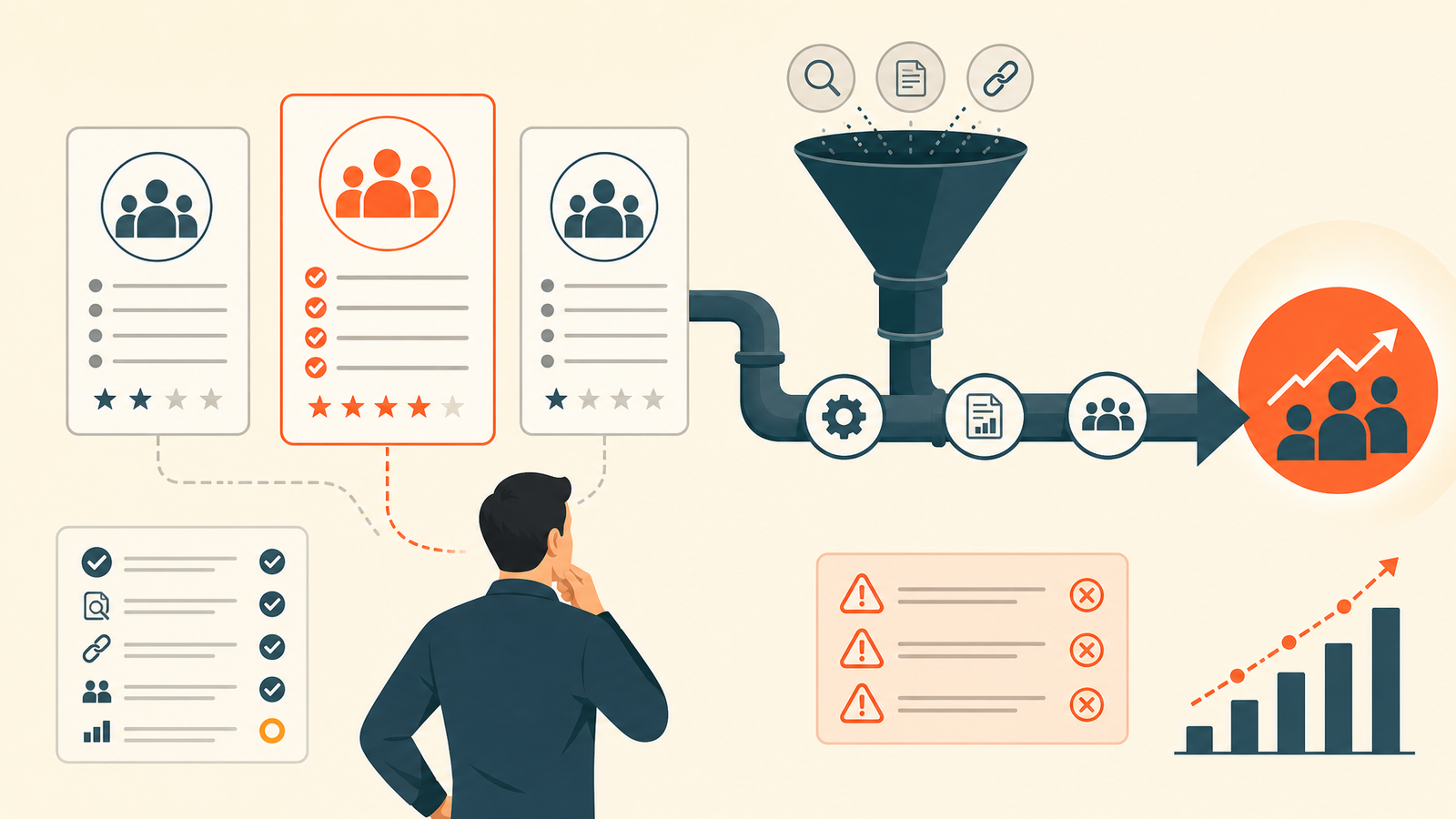
Choose a B2B SEO agency by checking whether it can connect your commercial goals to buyer-intent research, technical implementation, decision-stage content, and qualified pipeline reporting. Ask which pages it would prioritize, what it will own during the first 90 days, how it measures lead quality, and what it cannot guarantee. The right partner should show its reasoning, evidence, responsibilities, reporting limits, and contract terms. Be cautious when an agency sells rankings, traffic volume, or fast results without explaining how those activities support your sales process.
Most founders and marketing leaders comparing SEO proposals run into the same problem: every agency promises more traffic, better rankings, or a fixed number of blog posts per month. But the definitions of success are different in every deck, and none of them quite match what your sales team actually needs.
The real question is not whether an agency knows SEO terminology. It is whether the agency understands your buyers, your offer, your sales cycle, your most valuable pages, and how you plan to measure qualified pipeline. Those are harder to answer than keyword volume.
This guide gives you a practical evaluation framework covering services, questions, reporting, contracts, ownership, and red flags. Work through it before you book a single agency call.
What should a B2B SEO agency actually do?
A B2B SEO agency is a strategic and execution partner responsible for improving your company's visibility among buyers who are actively researching a problem, evaluating solutions, or comparing vendors. That means connecting technical foundations, commercial search intent, buyer-journey content, authority building, and qualified pipeline measurement into one coherent program.

Google's own guidance on hiring an SEO notes that a good SEO provider can genuinely improve your site but that irresponsible providers can do real damage. That tension is exactly why evaluation matters.

Here is what a complete B2B SEO program should cover:
| Service area | What it should include |
|---|---|
| Strategy | ICP alignment, commercial keyword mapping, funnel-stage prioritization, competitive gap analysis |
| Technical SEO | Crawlability, indexation, Core Web Vitals, structured data, internal linking, redirects |
| On-page SEO | Service pages, solution pages, meta data, heading structure, conversion paths |
| Content | Buyer-journey content, comparison pages, pillar and cluster structure, subject-matter review |
| Authority building | Relevant editorial links, digital PR, expert contributions, transparent methodology |
| Analytics and reporting | Google Search Console, Google Analytics, CRM integration, qualified lead definitions |
Kay Zee Consulting's B2B SEO services page confirms this scope across strategy, technical SEO, on-page work, content optimization, off-page SEO, and analytics and reporting.
How B2B SEO differs from B2C SEO
B2B SEO usually requires more attention to complex buying journeys, multiple stakeholders, specialized terminology, and sales handoff. The differences matter when choosing an agency.
| B2B SEO | B2C SEO |
|---|---|
| Longer sales cycles (weeks to months) | Shorter decision windows (hours to days) |
| Multiple stakeholders and a buying committee | Typically one buyer |
| Lower commercial search volumes with high intent | High search volumes, broader intent range |
| Service pages, solution pages, and comparison content drive conversions | Product pages and category pages drive conversions |
| Success measured partly through CRM and sales pipeline | Success often measured through ecommerce transactions |
| Subject-matter expertise signals trust to buyers | Brand awareness and social proof often drive preference |
A lower search volume does not mean a keyword is low value. In B2B, a query with 200 monthly searches that reaches a CFO evaluating a $50,000 software contract can be worth far more than a general term with 50,000 searches.
Start with the business outcome, not the keyword list
Before you review a single agency proposal, define what a qualified outcome actually looks like for your business. I have seen companies sign a 12-month SEO contract, receive consistent traffic growth, and still walk away frustrated because the leads were the wrong type, the sales team was not involved, and nobody defined what a qualified opportunity looked like at the start.
Run through this checklist first:
- ICP clarity: Can you describe the exact company size, industry, role, and problem that makes someone a qualified buyer?
- Priority offer: Which service or product do you most want to generate demand for right now?
- Commercial pages: Which pages should be ranking for buyer-intent queries, and what is their current condition?
- Lead qualification rules: How do you define an MQL, SQL, and a lost opportunity?
- Sales handoff: When does a marketing-qualified inquiry become a sales conversation, and who owns follow-up?
- CRM setup: Can you trace an inquiry from organic search to a closed deal today?
Then apply a quick proposal test: ask each agency to map three priority pages to one commercial outcome and one measurement method. A strong agency will have a clear answer. A weak one will talk about traffic.
B2B SEO strategy consulting should begin with this kind of commercial mapping, not a keyword spreadsheet.
Which pages should a B2B SEO agency prioritize first?
Priority depends on current performance, commercial value, technical condition, and buyer intent. There is no universal answer, but here is how to think about it:
| Page type | Buyer need it serves | What to check first |
|---|---|---|
| Service and solution pages | Solution evaluation, vendor comparison | Rankings, impressions, and conversion rate |
| Industry and vertical pages | Problem discovery within a specific sector | Indexation, relevance, and content depth |
| Comparison and alternative pages | Late-stage vendor shortlisting | Existence, quality, and search visibility |
| Integration pages | Technical buyers evaluating fit | Coverage and accuracy |
| Pricing explainers | Budget qualification and decision stage | Presence and clarity |
| Case studies and proof content | Risk reduction and social proof | Availability and specificity |
Google Search Console shows which pages receive impressions, clicks, and average position for specific queries. Start there before accepting any agency's prioritization recommendation.
I would also ask every candidate: what would you deliberately not prioritize in the first six months, and why? That question tells you more about strategic judgment than any ranking case study.
Evaluate the B2B SEO services included in the proposal
When you review a proposal, look past the service list and ask what evidence the agency can provide for each capability. Recommendations are not the same as implementation.
Technical SEO and website implementation
Technical SEO covers the systems that allow search engines to discover, crawl, render, and index your content. A weak technical foundation limits everything else.
Here is a practical checklist for evaluating technical capability:
- Does the agency audit crawlability and indexation, or just generate a report and hand it over?
- Who fixes broken redirects, crawl errors, and canonicalization issues – the agency or your developer?
- Does the agency understand rendering differences between server-side and client-side JavaScript frameworks?
- Can it assess and improve Core Web Vitals and mobile usability?
- Does it implement and validate structured data, or only recommend schema types?
- Who owns internal linking strategy and implementation?
- What access does the agency need to your CMS, hosting, and analytics tools to do the work?
The distinction between "we provide recommendations" and "we implement and validate fixes" is one of the most important things to clarify before signing. Many technical SEO gaps persist for months simply because nobody owns implementation.
Content strategy and commercial intent
Content strategy in B2B is not a publishing schedule. It is a map from buyer problem to commercial page to conversion action.
| Buyer stage | Content purpose | Page type |
|---|---|---|
| Problem awareness | Educate on category and symptoms | Blog, guide, explainer |
| Solution evaluation | Show how your approach works | Service page, comparison, use case |
| Vendor comparison | Build preference against alternatives | Versus page, case study, feature table |
| Decision and conversion | Remove objection and trigger action | Pricing explainer, demo page, proof content |
Reject a content plan that is defined only by monthly article volume. Ask instead how each piece maps to a specific buyer stage, a named commercial keyword cluster, and a next action for the reader. Strong B2B SEO services programs treat the service page as the anchor and build supporting content outward from it.
Also ask whether the agency uses subject-matter input from your team, or whether it produces content from keyword research alone. In B2B, industry terminology, client language, and technical specificity are difficult to replicate without internal knowledge.
Authority building and digital PR
Authority building supports search visibility through relevant editorial mentions, expert contributions, and earned links from credible publications. The quality of those links matters more than the number.
| Good practice | Warning practice |
|---|---|
| Relevant editorial placements in industry publications | High-volume link packages with no editorial context |
| Expert contributions linked to author and topic | Private blog networks or undisclosed paid placements |
| Transparent outreach methodology shared with client | Vague "link building" line item with no methodology |
| Clear ownership of existing links if the relationship ends | Links that are removed if the retainer is cancelled |
Ask whether links are placed in publications your buyers actually read. Ask what happens to those links if you leave. Google's guidance on hiring an SEO is clear that irresponsible link tactics can damage a site, and that buyers should research providers carefully.
How do you tell whether an agency can generate pipeline, not just traffic?
This is the central question. Traffic is a diagnostic signal. Pipeline is the business outcome. The gap between them is where most B2B SEO engagements disappoint.
Search Console, as documented by Google, measures queries, pages, impressions, clicks, and average position for Google Search. It does not measure lead quality, sales-qualified opportunities, or revenue. For those, you need analytics and CRM data working alongside it.
Google also explains that Search Console and Google Analytics measure different parts of the user journey and can be combined to understand search performance alongside on-site behavior. From there, CRM data extends the picture into pipeline and revenue where the measurement setup supports it.
As of August 31, 2026, Google has rolled out generative AI performance reports in Search Console to all websites worldwide. These reports show impressions in AI Overviews and AI Mode by page, country, and device, but do not yet include click or query data. They are a useful first signal for AI-search visibility, though they cover Google features only and cannot infer visibility in ChatGPT, Perplexity, or other platforms. (Google Search Console AI report availability confirmed September 2026.)
For B2B sales funnel optimization to work alongside SEO, the agency and client need a shared definition of what counts as a qualified lead from the start.
A practical rule I apply: every reported metric should have a decision attached. If a metric cannot answer "what do we do differently next month?" it is noise, not reporting.
Metrics a B2B SEO agency should report
Separate diagnostic signals from commercial outcomes. Both matter, but confusing them is how agencies survive on traffic growth while pipeline stays flat.

| Diagnostic metrics (search performance) | Commercial outcomes (business value) |
|---|---|
| Impressions by query and page (Search Console) | Qualified inquiries from organic search |
| Clicks and click-through rate | Marketing-qualified leads (MQLs) |
| Average position for priority keywords | Sales-qualified leads (SQLs) |
| Indexed pages and crawl coverage | Demo bookings and meetings booked |
| Core Web Vitals and technical health scores | Influenced pipeline value (where CRM tracks source) |
| AI Overview impressions (Search Console, September 2026) | Closed deals with organic source attribution |
A strong reporting conversation starts with: "What decision will this metric change next month?" If the agency cannot answer that, the report is a traffic dashboard, not a pipeline tool.
Questions to ask a B2B SEO agency before signing
These questions are designed to be used in an actual sales call. Group them by area and watch for vague or deflective answers.
Strategy and ICP
- Which three pages on our site would you prioritize first, and what commercial outcome maps to each?
- How do you research buyer language and industry terminology for a market you have not worked in before?
- What would make you tell us not to invest in SEO yet?
Technical SEO and implementation
4. Who audits, fixes, and validates technical changes – your team, our developer, or a shared process?
5. What CMS and hosting access do you need, and what happens if we cannot provide it?
6. How do you handle developer handoffs when our team is slow to implement?
Content
7. How do you map content to buyer stage rather than keyword volume?
8. Do you review content with our subject-matter experts, or produce it independently?
9. How do service pages, comparison pages, and supporting content relate in your program?
Authority and links
10. Where do links come from, and can you share a sample of recent placements?
11. What happens to those links if we end the engagement?
Reporting and attribution
12. How do you define a qualified lead from organic, and how is that connected to our CRM?
13. What is included in a monthly report, and what decisions does it support?
Contracts, ownership, and timelines
14. What do we own at the end of the engagement – content, links, data, and access?
15. What is the contract length, the review schedule, and the exit process?
16. What should we realistically expect in months three, six, and twelve?
What should the first 90 days look like?
A credible B2B SEO agency will give you a phased plan for the opening quarter. It should not be a guarantee, but it should show diagnostic discipline and prioritization logic.
A reasonable first-90-day plan typically covers:
- Days 1 to 30: Technical audit, Search Console and analytics review, keyword and competitor gap analysis, ICP alignment and commercial page mapping
- Days 31 to 60: Technical fix prioritization and implementation handoff, content brief development for priority pages, measurement setup and CRM source tagging
- Days 61 to 90: First content published or optimized, initial technical fixes validated, first reporting review with agreed metrics and decision logic
Be cautious if an agency presents a universal outcome timeline. SEO timelines depend on your site's technical condition, existing authority, competition, content quality, and implementation speed. No agency controls Google's crawl schedule or indexing decisions.
For the strategy layer of this planning, B2B SEO strategy consulting should produce a written prioritization rationale, not just a list of deliverables.
What are the biggest B2B SEO agency red flags?
Red flags are reasons to investigate further, not automatic proof of misconduct. But each one deserves a direct follow-up question.
| Red flag | Why it matters | What to ask next |
|---|---|---|
| Ranking guarantees | No agency controls Google's systems | "What happens contractually if those rankings are not achieved?" |
| Traffic-only reporting | Traffic growth without lead growth is a common failure mode | "How do you connect organic sessions to qualified leads and CRM data?" |
| Generic deliverables (X posts per month) | Output volume is not a strategy | "How does each piece map to a commercial keyword and a buyer stage?" |
| Undisclosed link methodology | Hidden tactics carry long-term risk | "Can you show me a sample of recent placements and the publications involved?" |
| No implementation support | Recommendations without execution stall indefinitely | "Who validates that technical fixes are live, and what is the escalation process?" |
| Unclear asset ownership | You may lose content or access if you leave | "What do we own at the end of the engagement?" |
| Long lock-in with no performance review | No accountability mechanism | "Is there a 90-day or 6-month performance review with exit rights?" |
| Junior team after the pitch | Senior strategy, junior execution | "Who will be the day-to-day contact, and can we meet them before signing?" |
Why ranking guarantees and fast-result promises are risky
No agency can responsibly guarantee specific Google rankings. Google's own documentation states clearly that meeting content requirements does not guarantee crawling, indexing, or serving of a page. That applies to standard search results and to AI features.
Apply a three-point test to any promise:
- Is it framed as a forecast based on evidence, or as a contractual commitment?
- Does it distinguish between search performance signals and business outcomes?
- Does the agency explain what could prevent the result, not just what could produce it?
Early technical fixes can sometimes produce faster signals in Search Console. But ranking movement, click-through rates, and qualified pipeline conversion depend on dozens of variables outside any agency's direct control.
Should you choose an agency, consultant, in-house team, or hybrid model?
The right model depends on your biggest constraint, not your budget alone.

| Model | Best when | Watch for |
|---|---|---|
| B2B SEO agency | You need strategy, content, technical work, and reporting from one team | Delivery may shift to junior staff after onboarding |
| Independent consultant | You have internal execution capacity and need strategic direction | Limited bandwidth for simultaneous technical, content, and authority work |
| In-house SEO | Long-term program with strong CMS access and internal knowledge | Slower to build specialist depth; single point of failure |
| Hybrid (agency plus in-house) | Internal team owns CMS and content approval; agency handles strategy and authority | Coordination overhead; clear RACI required from the start |
The bottleneck question is the selection criterion. If your constraint is strategy and prioritization, a consultant or senior agency engagement makes sense. If your constraint is execution capacity and content production, an agency or hybrid model is more practical. If your constraint is internal knowledge and subject-matter depth, you need strong internal editorial involvement regardless of model.
Do not compare models purely on fees without confirmed current pricing from official vendor sources.
When is a B2B SEO agency not the right fit?
SEO may be premature or ineffective in these situations. Run this readiness check before booking agency calls:
- Unclear positioning: If your offer is not differentiated or the ICP is not defined, SEO will attract the wrong traffic and the wrong leads.
- Site cannot be changed: If your CMS is locked, IT approvals take months, or there is no developer resource, technical recommendations will stall.
- No sales follow-up process: Leads from organic search require timely, relevant follow-up. If the sales function is not ready, lead quality becomes irrelevant.
- No CRM or lead tracking: Without source attribution in the CRM, measuring SEO's contribution to pipeline is not possible.
- No internal content owner: Long-form B2B content requires subject-matter input. If no internal expert can review or contribute, content quality will be generic.
- Offer not yet validated: If you are still testing product-market fit, paid channels with faster feedback loops may be a better first investment.
For companies in this position, B2B sales funnel optimization and offer clarity often need to come before an SEO program can create measurable outcomes.
How Kay Zee Consulting fits this decision framework
Kay Zee Consulting is a boutique B2B performance marketing and consulting firm. Its official service pages describe B2B SEO strategy, technical SEO, on-page optimization, content optimization, off-page SEO, and analytics and reporting, alongside B2B SEO strategy consulting, funnel optimization, and related performance marketing services.

The firm's stated audience includes founder-led B2B startups, SaaS and AI product companies, consultants, professional services firms, and growing SMEs across the UAE, GCC, Pakistan, Singapore, and the wider Middle East. For SaaS companies specifically, Kay Zee Consulting also offers B2B SaaS marketing support.
Disclosure: Kay Zee Consulting offers B2B SEO and related performance marketing services. It is included here as an example of the type of provider this framework is designed to evaluate, not as an independently ranked winner. Founders and marketing leaders should apply the questions and criteria in this article to any agency they evaluate, including this one.
Kay Zee Consulting is not the right fit for every company. Enterprises needing large-scale content production teams, or companies outside the B2B sector, should evaluate providers specifically suited to those requirements.
Frequently asked questions about choosing a B2B SEO agency
What does a B2B SEO agency do?
A B2B SEO agency helps business-to-business companies improve search visibility, buyer-journey content, technical performance, and measurable lead generation tied to pipeline and revenue.
How do I choose a B2B SEO agency?
Choose a B2B SEO agency by evaluating its strategy approach, implementation ownership, commercial content capability, reporting model, attribution method, and contract terms before signing.
How is B2B SEO different from B2C SEO?
B2B SEO typically requires more attention to complex buying journeys, multiple stakeholders, specialized terminology, longer sales cycles, and a clear connection between organic discovery and sales handoff.
What services should a B2B SEO agency include?
A complete B2B SEO program may include strategy, technical SEO, on-page optimization, content aligned to buyer stages, authority building, analytics setup, and conversion support.
What questions should I ask a B2B SEO agency?
Ask which pages the agency would prioritize, what it will implement directly, how it defines qualified leads, what it owns versus recommends, and what it cannot guarantee.
Can a B2B SEO agency guarantee rankings?
No agency can responsibly guarantee specific Google rankings because crawling, indexing, ranking, and user behavior are outside any third party's control, as Google's documentation confirms.
How long does B2B SEO take?
B2B SEO timelines depend on the site's technical condition, existing authority, competitive landscape, content quality, and implementation speed. No universal timeline applies.
How much does B2B SEO cost?
B2B SEO pricing varies by scope, market, technical complexity, content requirements, and implementation responsibility. Fees differ significantly by provider; request a scoped proposal rather than a generic rate.
Should I hire a B2B SEO agency or build an in-house team?
Choose based on your biggest constraint: strategy and specialist expertise points toward an agency or consultant; long-term execution with internal knowledge often supports a hybrid or in-house model.
Does a B2B SEO agency need AEO or GEO services?
A B2B SEO agency should understand how clear, useful, well-structured content can support modern search experiences including AI Overviews and AI Mode. Google states that foundational SEO best practices remain relevant to AI features, with no separate technical requirements. No provider should guarantee AI citations. As of August 31, 2026, Google Search Console includes a generative AI performance report for AI Overviews and AI Mode impressions, confirmed globally available.
Use this checklist before choosing your SEO partner
Before you sign with any B2B SEO agency or B2B SEO company, confirm that each point is true:
- The agency can describe your buyers, offer, and the commercial search intent you need to own.
- The proposal prioritizes specific pages and problems, not just keyword volume or content quantity.
- Technical recommendations have a named implementation owner and a validation process.
- Content includes service pages and decision-stage resources, not only informational blog posts.
- Reporting connects Search Console and analytics signals with qualified lead definitions and CRM data.
- Contract terms, asset ownership, access requirements, deliverables, review checkpoints, and exit conditions are clearly documented.
If any of these points is unclear after two conversations with an agency, that is worth treating as a red flag before you commit.
If you want an outside assessment of your current B2B SEO readiness, funnel setup, and pipeline measurement, Kay Zee Consulting offers a strategy conversation for founder-led B2B companies and SaaS teams. You can find more B2B marketing insights on the Kay Zee Consulting blog, or speak directly with the team about whether SEO is the right channel for your current stage.