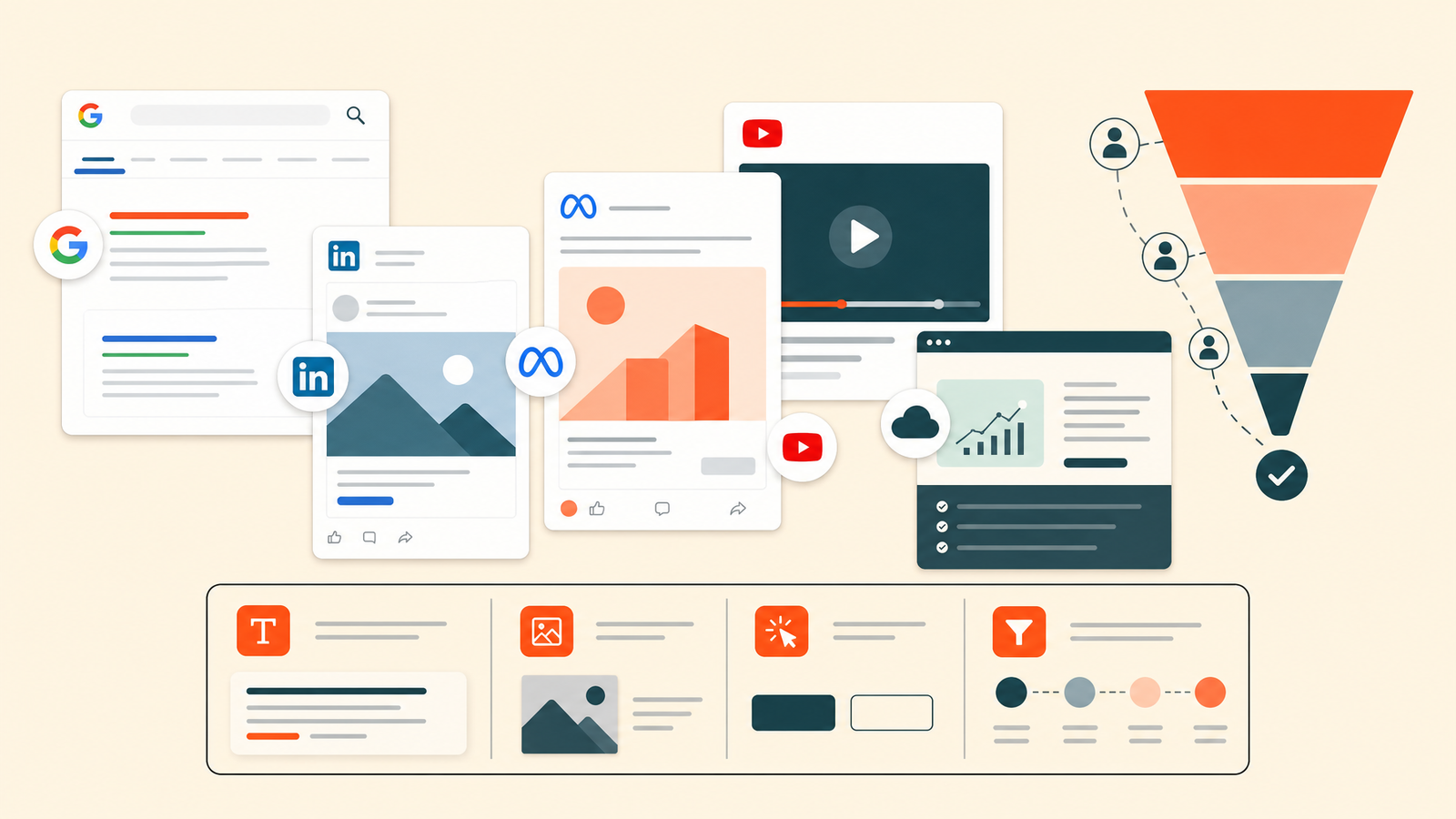
The most useful B2B ad examples show more than a headline or image. Each example should explain the audience, pain point, offer, creative format, CTA, funnel stage, landing page, and qualification path. Google Ads can capture existing search demand, LinkedIn Ads can reach defined professional audiences, and Meta or YouTube can support awareness and retargeting. The right choice depends on intent and qualified pipeline rather than clicks alone.
You have probably scrolled past a B2B ad that looked polished and thought: should I be running something like that? The problem is that most roundups stop at the creative. They show you the headline and the visual, but they skip the parts that actually matter: who the ad targets, what offer it makes, how it qualifies the lead, and whether the landing page continues the same conversation.
The goal here is not to copy another company's colors or wording. It is to understand the audience, the offer, the objection being addressed, the CTA, and the landing-page connection behind each example. That is the structural pattern worth borrowing.
One important ground rule before the examples: a visible ad is not proof that it generated revenue. An ad can be active, attractive, and widely seen without having produced a single qualified opportunity. Where examples below are illustrative templates rather than verified live campaigns, they are labeled as such.
What Makes a B2B Ad Effective?
Before evaluating any example, it helps to have a consistent scoring lens. The seven attributes below are observable from a public ad. They do not require access to private campaign data.
The seven attributes to record for every B2B ad example
| Attribute | What to look for | Why it matters |
|---|---|---|
| Audience | Job title, seniority, industry, company size | Determines whether the ad reaches the actual decision-maker |
| Pain point | The specific problem stated or implied | Explains why the reader should care |
| Offer | What the buyer receives by clicking | Connects the ad to funnel intent and conversion friction |
| Proof | Sourced stats, named customers, review references | Supports credibility when verifiable |
| Creative format | Image, video, document, carousel, text | Affects platform fit and message depth |
| CTA | Exact next step requested | Shows whether the ask matches the funnel stage |
| Landing-page alignment | Whether the page continues the ad promise | Most commonly missing in weak B2B campaigns |

An ad can score well on all seven attributes and still underperform in a specific market, industry, or buying cycle. These attributes evaluate observable strategy, not private performance data. The evaluation approach and all examples below were reviewed against current platform documentation in September 2026.
How Can You Judge a B2B Ad Example Without Seeing Its Performance Data?
You cannot confirm performance from creative alone. This distinction matters because a lot of B2B advertising inspiration is drawn from ads that look professional, run for a long time, or attract visible engagement, none of which prove they generated qualified pipeline.
What the ad shows versus what the ad proves
Think of it as an evidence ladder with five levels:
- The ad exists – confirmed via the Google Ads Transparency Center, Meta Ad Library, or LinkedIn Ad Library
- The ad ran over time – visible longevity suggests continued spend, not profitability
- The ad attracted engagement – comments and shares signal resonance, not conversion
- The advertiser reports conversion data – requires first-party analytics or platform reporting
- The advertiser reports qualified pipeline or revenue – requires CRM data, named sources, or a published case study

Most publicly available B2B ad examples sit at level one or two. The illustrative examples in this article are labeled clearly. Where a real ad pattern is described, it reflects observable format mechanics and strategy, not claimed results.
B2B Search Ad Examples
Google Ads, specifically Responsive Search Ads (RSAs), allow up to 15 headlines and 4 descriptions that Google combines dynamically. Each headline is up to 30 characters; each description up to 90 characters. This format rewards writing multiple specific, non-redundant assets rather than one polished version.
For B2B PPC and Google Ads services, the search channel works best when buyers are already searching for a category solution, vendor comparison, or specific service. It is less suited to creating demand from audiences who do not yet know the category exists.
Search ad example card format
Example 1 (Illustrative): B2B SaaS tool targeting IT managers
- Query intent: "project management software for IT teams"
- Audience: IT managers and operations leads at companies with 50 to 500 employees
- Sample headline structure: "Manage IT Projects in One Dashboard | Free 14-Day Trial | Trusted by 2,000+ Teams"
- Offer: Free trial with onboarding support
- CTA: Start free trial
- Landing page: Trial sign-up page with IT-specific social proof, not the generic homepage
- Adaptation note: If your trial does not include onboarding support, do not state it
Example 2 (Illustrative): B2B consulting firm targeting operations directors
- Query intent: "supply chain consulting UAE"
- Audience: Operations and procurement leaders in manufacturing and logistics
- Sample headline structure: "Supply Chain Audit | 90-Minute Expert Review | Book Your Session This Week"
- Offer: Time-boxed diagnostic audit with a concrete deliverable
- CTA: Book your audit
- Landing page: Audit description page with methodology, outcome, and booking form
- Adaptation note: Specify what the buyer receives, not just what you do
Example 3 (Illustrative): B2B software targeting finance teams
- Query intent: "accounts payable automation software"
- Audience: CFOs and finance managers at mid-market companies
- Sample headline structure: "Cut AP Processing Time | Automate Invoice Approvals | See a Live Demo"
- Offer: Personalized product demonstration
- CTA: Book a demo
- Landing page: Demo booking page with role-specific proof, not a general features list
- Adaptation note: Match the demo page headline to the query
Example 4 (Illustrative): B2B agency targeting marketing directors
- Query intent: "B2B lead generation agency"
- Audience: Marketing directors and growth leads seeking pipeline support
- Sample headline structure: "B2B Lead Generation Agency | Strategy-First, Pipeline-Focused | Get a Free Audit"
- Offer: Free paid media audit
- CTA: Get your free audit
- Landing page: Audit description with scope, output, and qualification questions
- Adaptation note: Qualify the reader with a short question before the form submission
B2B LinkedIn Ad Examples
LinkedIn Ads offer targeting by job title, seniority, industry, company size, and specific employer, which makes them well-suited for account-based marketing (ABM) and buying-committee campaigns. According to LinkedIn Marketing Solutions, the main formats include Single Image Ads (Sponsored Content), Video Ads, Document Ads, and Lead Gen Forms. Platform features and availability can vary by account, region, and objective.

For B2B social media advertising services, LinkedIn examples should be judged by audience fit, offer quality, form friction, and follow-up path, not by professional appearance alone.
LinkedIn ad example card format
Example 5 (Illustrative): Gated research report for senior buyers
- Format: Single Image Ad with Lead Gen Form
- Audience: VPs and Directors in financial services, targeting companies with 200 or more employees
- Offer: Original research report on regional fintech compliance
- CTA: Download the report
- Form path: LinkedIn Lead Gen Form pre-filled with job title, company, and email
- Qualification method: Title and company size filter in audience settings, followed by sales review before follow-up
- Adaptation note: If your research is not original, a curated guide is honest; a report is not
Example 6 (Illustrative): Document Ad for technical evaluators
- Format: LinkedIn Document Ad (carousel-style PDF preview)
- Audience: IT architects and senior developers at enterprise technology companies
- Offer: Technical integration checklist for a SaaS platform
- CTA: Read the checklist
- Landing path: Full document accessible in-feed; follow-up via retargeting to anyone who engages
- Qualification method: Retargeting audience built from document engagers, then routed to a demo offer
- Adaptation note: Label the document's page count and reading time in the ad copy
Example 7 (Illustrative): Video Ad for founder-led brand awareness
- Format: LinkedIn Video Ad
- Audience: Founders and CEOs at B2B SaaS companies with 10 to 100 employees
- Offer: 90-second explanation of the problem the product solves, no sales pitch
- CTA: Learn how it works
- Landing page: Short explainer page with one clear next step
- Qualification method: Retarget video viewers who watched more than 50% with a consultation offer
- Adaptation note: A video that only shows the product interface rarely outperforms one that addresses the buyer's frustration first
Example 8 (Illustrative): ABM nurture campaign for named accounts
- Format: Sponsored Content with account targeting
- Audience: Specific named accounts on a target list, across job functions
- Offer: Case study from a comparable company in the same industry
- CTA: Read the case study
- Landing page: Case study page with a soft consultation CTA at the bottom
- Qualification method: Account is already in CRM; this campaign accelerates familiarity before the sales team reaches out
- Adaptation note: Different roles in the same account need different messages; the CFO and the IT manager are not reading for the same reason
| Role | Message emphasis | Preferred offer |
|---|---|---|
| Economic buyer (CEO, CFO) | ROI, risk reduction, strategic fit | Case study, executive brief |
| End user | Ease of use, workflow improvement | Product tour, demo |
| Technical evaluator | Integration, security, compliance | Technical checklist, documentation |
| Internal champion | Peer proof, talking points for approval | Comparison guide, ROI calculator |
B2B Meta, YouTube, and Retargeting Ad Examples
Meta Ads (Facebook and Instagram) are not the first instinct for many B2B advertisers, but they serve a clear role when the offer is easy to understand visually, the audience is large enough to test, and follow-up and qualification are in place. According to Meta's lead generation guidance, lead campaigns can route submissions directly to a CRM, which matters for B2B qualification speed.
Channel role and creative adaptation
The same offer behaves differently across channels. Here is how one B2B consulting offer adapts:
Example 9 (Illustrative): Meta awareness ad for a B2B consultancy
- Format: Single image or short video in Facebook and Instagram feed
- Audience: Business owners and founders in target industries, broad by job function but narrowed by interest signals
- Offer: Educational post or short guide on a common operational problem
- CTA: Read the guide
- Landing page: Blog post or guide with a soft lead-capture form at the end
- Adaptation note: Cold Meta audiences rarely convert on a hard sales CTA; use low-friction educational offers first
Example 10 (Illustrative): YouTube pre-roll for a B2B SaaS product
- Format: Skippable in-stream YouTube ad (5 seconds before skip)
- Audience: Custom intent audiences based on relevant search queries, or customer-match lists
- Offer: Product demonstration clip showing one specific workflow improvement
- CTA: Watch the full demo
- Landing page: Product demo video page or trial sign-up
- Adaptation note: The first 5 seconds must state the problem and audience before the viewer skips
Example 11 (Illustrative): Meta retargeting ad for website visitors
- Format: Carousel or single image retargeting ad
- Audience: Visitors to the pricing or services page who did not convert
- Offer: Free consultation or audit
- CTA: Book a 30-minute call
- Landing page: Consultation booking page with clear scope and outcome description
- Adaptation note: Retargeting works when the offer escalates the conversation, not when it repeats the original message
B2B SaaS Ad Examples
SaaS advertising follows three distinct buying motions, and confusing them is one of the most common structural mistakes I see in B2B campaigns. Product-led growth (PLG) companies want users to self-serve. Sales-led companies want a qualified conversation. Hybrid models want a low-friction first step that routes into a sales process.
SaaS ad examples by buying motion
Example 12 (Illustrative): Product-led SaaS – free trial
- Buying motion: Product-led
- Audience: Individual contributors and managers who can sign up without committee approval
- Offer: Free trial with no credit card required
- Headline structure: "Start Free. See Results in Your First Week. No Credit Card Needed."
- CTA: Start free trial
- Landing page: Frictionless sign-up page with 3 to 5 bullet proof points, not a full features list
- Qualification note: Product usage data qualifies the lead; the sales team follows up on active accounts
Example 13 (Illustrative): Sales-led SaaS – demo request
- Buying motion: Sales-led
- Audience: Senior managers and directors who need stakeholder approval
- Offer: Personalized product demonstration scoped to the buyer's use case
- Headline structure: "See How [Category] Teams Cut [Specific Task] Time | Book Your Demo"
- CTA: Book a demo
- Landing page: Demo page with role-specific value statements, a short qualification form, and social proof from comparable companies
- Qualification note: Form asks for company size and primary use case to route to the right sales rep
Example 14 (Illustrative): Comparison or migration SaaS message
- Buying motion: Sales-led or hybrid
- Audience: Buyers who are actively evaluating alternatives to an existing tool
- Offer: Side-by-side comparison guide or migration support offer
- Headline structure: "Switching from [Competitor Category]? See What [Product] Does Differently."
- CTA: Read the comparison
- Landing page: Honest comparison page with feature table, migration FAQ, and a soft CTA
- Qualification note: Visitors to a comparison page are high-intent; follow up quickly and specifically
B2B Professional Services Ad Examples
Professional services advertising works best when the offer is concrete rather than a broad capability list. "We help businesses grow" is not an offer. "A 90-minute paid media audit with a prioritized recommendation list" is an offer. The difference determines whether a buyer can picture what they are getting.
Professional services ad examples by offer
Example 15 (Illustrative): Audit-led offer for an agency
- Audience: Marketing directors and founders running underperforming paid media campaigns
- Offer: Free paid media audit with a written output
- Headline structure: "Is Your Ad Budget Generating Pipeline? Get a Free Audit and Find Out."
- CTA: Get your free audit
- Landing page: Audit scope page describing what is reviewed, what the output looks like, and who it is for
- Not for everyone: This offer is not suitable for companies spending less than a minimum monthly threshold on paid media, because the audit output would not have enough data to be useful
Example 16 (Illustrative): Expertise-led content ad for a consultant
- Audience: CEOs and operations leads at professional services firms
- Offer: Short guide or framework on a defined business problem
- Headline structure: "How B2B Professional Services Firms Build Referral-Proof Sales Pipelines"
- CTA: Read the guide
- Landing page: Guide landing page with a soft email capture
- Qualification note: This is a top-of-funnel content ad; qualification happens after the follow-up email sequence
Example 17 (Illustrative): Proof-led case study promotion
- Audience: Buyers at a similar stage or industry to the case study subject
- Offer: Published case study or client story
- Headline structure: "How a [Industry] Company Reduced [Problem] by [Outcome] in [Timeframe]"
- CTA: Read the case study
- Landing page: Full case study page with methodology, result, and a consultation CTA
- Qualification note: Only use case studies with client permission and verifiable outcomes; remove invented numbers
What Should B2B Ad Copy Say at Each Funnel Stage?
The same company often needs three different campaigns running at the same time, because different buyers are at different stages of the B2B buyer journey. The mistake is running one ad to all of them.
| Funnel stage | Buyer state | Offer type | CTA direction | Landing page |
|---|---|---|---|---|
| Awareness | Recognizing a problem | Guide, research, short video | Read / Watch / Download | Blog post, guide, or video page |
| Consideration | Evaluating options | Webinar, checklist, comparison | Register / Get the checklist | Webinar page, comparison guide |
| Decision | Ready to act | Demo, audit, consultation | Book / Get started | Booking page with clear scope |

Awareness-stage B2B ad copy
At awareness stage, the buyer does not yet know your product is the answer. They know they have a problem. The ad copy should name that problem clearly, not your solution. Educational offers such as guides, short videos, and research reports work here. CTAs like "Read the guide" or "Watch the 3-minute overview" are lower friction than "Book a call." A B2B sales funnel optimization approach treats these touches as pipeline seeds, not immediate revenue.
Consideration-stage B2B ad copy
At consideration stage, the buyer is comparing options and building a shortlist. Comparison content, diagnostic tools, checklists, and role-specific proof perform well here. The message can be more direct about your offer. Including a real customer reference, a methodology, or a specific outcome from a verifiable source raises credibility. Webinars and workshops also work here because they qualify interest before the sales conversation.
Decision-stage B2B ad copy
At decision stage, the buyer is ready to act but may still need a concrete next step. Demos, consultations, and audits work well. The CTA should be specific about what happens after the click: how long the call is, who they speak with, and what they receive. Qualification questions in the form reduce friction only when the buyer understands why they are being asked.
Common Mistakes in B2B Ads
After 15 years in B2B demand generation, these are the patterns that consistently produce qualified leads in volume, and the mistakes that consistently prevent it.

Vague audience targeting. Targeting "business decision makers" without specifying industry, company size, or role means the ad reaches too many people who cannot buy. Diagnostic question: Who exactly is this ad for, and can the platform settings reflect that?
One message for the whole buying committee. The CFO and the IT manager have different objections. Running one ad to both means neither feels spoken to. Diagnostic question: Does the ad speak to a specific role's concern?
Broad capability lists instead of concrete offers. "We help businesses scale" is a positioning statement, not an offer. Diagnostic question: If the reader clicks, what do they get?
Unsupported statistics. Using benchmark numbers without a named source signals low credibility to sophisticated buyers. Diagnostic question: Can this claim be traced to a named, verifiable source?
Too many form fields. Asking for company revenue, headcount, and budget in a single cold-audience form increases drop-off. Diagnostic question: Is each field essential for qualification, or just nice to have?
Landing page mismatch. The ad promises an audit; the landing page shows a generic services list. The buyer bounces. Diagnostic question: Does the landing page headline match the ad headline?
No sales follow-up plan. Generating leads without a defined follow-up SLA means qualified buyers go cold. Diagnostic question: What happens to a submitted lead within the first 24 hours?
Measuring clicks instead of qualified pipeline. A high click-through rate on a LinkedIn campaign means nothing if none of those clicks become MQLs, SQLs, or opportunities. According to Metadata's 2026 B2B advertising benchmarks, Google Ads cost per lead across 153 B2B advertisers averaged $524, far above social channels, but search intent is fundamentally different from feed-based interruption. Clicks and cost per click are not the right primary metrics for most B2B campaigns. Diagnostic question: Is the campaign measured against qualified leads, pipeline value, or revenue?
How Do You Adapt These B2B Ad Examples to Your Own Campaign?
Adapt the structure, not the brand's wording, visual identity, or unsupported claims. Here is a practical six-step sequence.
Choose the audience and buying committee
Start by naming the exact job title, seniority level, industry, company size, and geography of the buyer. Then identify who else influences the decision: the economic buyer who approves spend, the end user who evaluates day-to-day fit, the technical evaluator who assesses integration and security, and the internal champion who sells the idea internally. Each role may need a different message and offer.
Match the offer to intent
Do not send cold audiences directly to a high-friction sales CTA without context. A buyer who has never heard of your company is not ready to book a 60-minute consultation. Start with an offer that matches where the buyer is in the B2B buyer journey. Use content and education for cold audiences, and escalate to demos and audits for warm audiences who have already engaged.
Measure qualified pipeline, not clicks alone
Define what a qualified lead means before the campaign starts. Is it an MQL (marketing-qualified lead) based on content engagement? An SQL (sales-qualified lead) based on a sales conversation? An opportunity with a defined pipeline value? Without these definitions and the CRM tracking to support them, the campaign will be measured on the wrong signals. B2B ad budgets in 2024 grew LinkedIn allocation from 31% to 39% of total spend by year-end, according to Dreamdata's 2025 benchmarks, reflecting a shift toward channels where audience intent and pipeline attribution are more directly traceable.
Campaign adaptation brief template:
| Field | Your input |
|---|---|
| Target audience (role, seniority, industry, size) | |
| Primary pain point in the buyer's language | |
| Offer (what they receive by clicking) | |
| Proof (sourced, verified, or removed) | |
| CTA (specific next step) | |
| Landing page URL and headline match | |
| Qualification criteria | |
| Measurement event (MQL, SQL, opportunity) | |
| CRM owner and follow-up SLA |
When Kay Zee Consulting May Be a Fit
If you have a defined B2B offer, a viable landing page, and a sales process ready to handle inbound leads, Kay Zee Consulting's B2B performance marketing services are built to turn paid media and demand generation into measurable pipeline.

The firm's paid media and demand generation support covers:
- Google Ads and B2B PPC: High-intent search campaigns mapped to qualified pipeline, not just clicks
- LinkedIn and Meta advertising: Audience-specific B2B social campaigns for awareness, lead generation, and ABM
- Funnel and landing-page alignment: Making sure the ad promise continues through the conversion path
If you want to explore whether a structured campaign approach makes sense for your business, you can book a B2B strategy call to discuss your current situation.
Disclosure: Kay Zee Consulting provides B2B performance marketing services including PPC, social advertising, SEO, and funnel optimization. The examples and guidance in this article are educational. They are not a guarantee of campaign results.
When This Is Not the Right Fit
Paid media support is not the right starting point for every B2B company. It may not be the right fit when:
- The core offer is not clearly defined or differentiated from competitors
- There is no landing page that can deliver on the ad promise
- There is no sales team or follow-up process to handle inbound leads
- Conversion tracking is not in place, so qualified pipeline cannot be measured
- The primary need is brand-only creative production rather than campaign strategy and execution
In these situations, getting the foundation right first will produce better results than starting ad spend.
B2B Ad Examples FAQ
What are B2B ad examples?
B2B ad examples are paid advertisements aimed at influencing a business purchase decision. A useful example includes the audience, offer, message, CTA, funnel stage, and landing-page destination, not just the creative.
What makes a good B2B ad?
A good B2B ad makes the intended buyer, problem, offer, and next step immediately clear. Visible quality does not prove campaign performance; only first-party data can do that.
Which platform is best for B2B advertising?
The best platform depends on buyer intent, audience reach, offer type, sales cycle length, and measurement quality. No single channel wins for every B2B company or market.
Are Google Ads or LinkedIn Ads better for B2B?
Google Ads captures active search intent from buyers already looking for a solution. LinkedIn Ads can reach defined professional attributes and account-level audiences. Actual performance depends on the specific campaign, offer, and audience.
Should B2B companies use Meta Ads?
B2B companies can use Meta Ads effectively for awareness, education, retargeting, and selected lead-generation campaigns. Qualification and rapid follow-up matter more on Meta than on search channels.
What should a B2B ad CTA say?
The CTA should describe the exact next step and match the reader's funnel stage. Examples include "Read the guide" at awareness stage, "Watch the demo" at consideration stage, and "Book your audit" at decision stage.
How do I write B2B ad copy?
Start with a defined buyer problem stated in the buyer's language. Connect it to one concrete offer, add credible and sourced proof, and make the next step specific. Testing multiple versions is recommended; no version is guaranteed to win.
How do I know whether a B2B ad example actually worked?
You need first-party conversion, qualified-lead, pipeline, or revenue evidence to confirm performance. An ad library confirms that an ad ran; it does not confirm that it generated revenue.
Do B2B ads need a landing page?
Many B2B campaigns benefit from a dedicated landing page that matches the ad promise and CTA. Some platforms, including LinkedIn, offer native lead forms that create an in-platform conversion path without requiring a separate page.
How can I adapt an ad example without copying it?
Copy the strategic pattern: the audience definition, offer type, CTA direction, and landing-page logic. Do not copy the wording, visual identity, proof claims, customer stories, or any proprietary creative elements. Always use original copy and rights-cleared creative.
Final Decision Framework and Next Steps
Before committing to a B2B advertising campaign based on any example, run through this three-part framework:
- Choose the buyer and funnel stage. Who exactly is this ad for, and where are they in the decision process?
- Choose the offer and channel that match that intent. A cold audience on LinkedIn needs a different offer from a warm retargeting audience on Meta or a high-intent search query on Google.
- Choose the measurement event that reflects qualified pipeline. Clicks, impressions, and CTR are inputs, not outcomes. MQL, SQL, opportunity, and pipeline value are the signals that matter.
Then run a quick pre-launch checklist:
- Can the buyer identify themselves in the ad within the first line?
- Is the problem stated specifically, not generically?
- Is the offer concrete and deliverable?
- Is the proof sourced and verifiable?
- Does the landing page headline match the ad headline?
- Is the CTA appropriate for where the buyer is in the funnel?
- Is there a qualification path and a follow-up plan ready before the campaign goes live?
If any of these answers is unclear, fixing the foundation will return more than starting spend on a campaign that sends the wrong buyer to the wrong page.
For companies in the UAE, GCC, Saudi Arabia, Qatar, Pakistan, and wider Middle East markets, B2B advertising decisions also need to account for platform availability, regional targeting options, and local market dynamics that may differ from global benchmarks. If you want a structured view of how these examples apply to your specific market and offer, book a B2B strategy call with the Kay Zee Consulting team.