Most businesses start marketing the same way. And most businesses hit the same wall.
You launch your business. You’re excited. You’ve got a product you believe in and a target customer in mind.
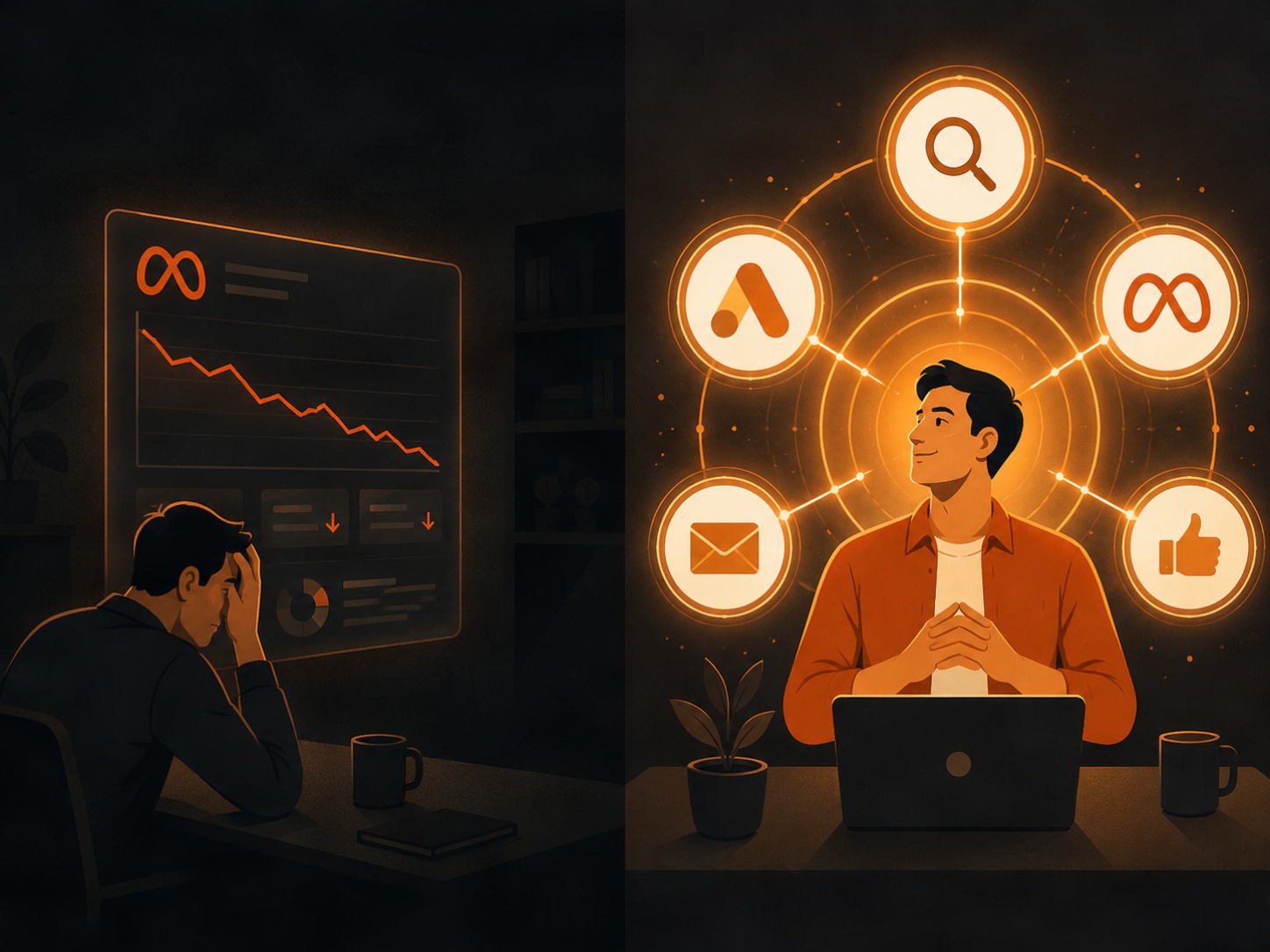
So you do what everyone around you is doing. You hire a social media manager, brief a designer on creatives, set up a Meta Ads account, and start running campaigns. Reels go up. Carousels go live. The boosted posts are flowing.
And then you wait.
Three months pass. Then six. The budget has been spent. The agency or freelancer sends you reports full of impressions and reach numbers. But the phone isn’t ringing the way you expected. The leads are thin. The sales aren’t there.
What went wrong?
The Illusion of Activity
Here’s the uncomfortable truth most businesses discover too late: being active on one channel feels like marketing. But it isn’t a marketing strategy.
Meta Ads and social media content are powerful tools. Nobody is disputing that. But they are one piece of a much larger puzzle. When businesses pour everything into a single channel, they aren’t building a marketing engine. They’re renting attention from one platform and hoping it converts.
And when it doesn’t, the post-mortem usually points at the creative. Or the targeting. Or the algorithm. Rarely does anyone ask the more important question: were we even showing up where our customer was looking?
The Channel Your Customer Is Already Using
Think about this for a moment.
A business owner in types “best accounting software for small business” into Google. They are not browsing. They are not scrolling. They are actively looking for a solution. Their credit card is metaphorically already in their hand.
SEO and Google Ads put you directly in front of that person at that exact moment. Meta Ads, no matter how well targeted, cannot replicate that intent. Social content cannot either. These channels serve a different purpose entirely.
This is the gap that most early-stage businesses miss. They invest heavily in channels that create awareness and build familiarity, while completely ignoring channels that capture demand that already exists.
The customer was already looking. The business just wasn’t there.
What Each Channel Actually Does
Before a business can build a multichannel strategy, it needs to understand what each channel is actually built for. Because treating them as interchangeable is where most of the confusion starts.
SEO is a long game. It takes time to build, but once it works, it compounds. A well-ranked page drives traffic for months or years without ongoing spend. It captures people who are actively searching for exactly what you offer.
Google Ads is the paid version of that same intent. You appear immediately, in front of people who are already searching. The ROI is highly measurable and the feedback loop is fast.
Meta Ads operate on a fundamentally different psychology. You are interrupting someone’s scroll. Done well, you can create awareness, build desire, and drive impulse purchases. It is particularly powerful for D2C brands, products with strong visual appeal, and retargeting warm audiences.
Email marketing is the most underrated channel in most early-stage businesses. It keeps your existing audience warm. It converts browsers into buyers and buyers into repeat customers. It costs almost nothing to run and consistently delivers among the highest ROI of any digital channel.
Social content is your long-term trust infrastructure. It is not a sales channel. It is a credibility channel. When a potential customer finds you through any other channel, they will come to your Instagram or LinkedIn to decide if you are real, if you are credible, and if they like you. What they find there matters enormously.
None of these channels can fully replace the others. Each one does something the rest cannot.
The Invisible Business Problem
Here is a simple way to think about it.
Every channel represents a place where your potential customer might be looking for you. When you are only present on one of those channels, you are invisible on all the others. And your customer does not know which channel you chose.
They might find you through a Google search. They might discover you through a friend’s email forward. They might see your ad while scrolling at midnight. They might read a LinkedIn post that a colleague shared.
You do not get to choose how they find you. You only get to choose whether you are there when they look.
The businesses that rely on a single channel are making a bet that their customer will find them through that one specific door. Most of the time, that bet loses.
How the Smarter Businesses Approach This
The businesses that figure this out early do not necessarily spend more. They spend differently.
They start with a presence across all the major channels, even if it is minimal. A basic SEO foundation. A small Google Ads budget targeting high-intent keywords. A Meta campaign. An email list with a simple welcome sequence. Consistent but lightweight social content.
They are not chasing scale. Not yet. They are chasing signal.
Which channel is bringing in the most qualified leads? Where is the cost per acquisition lowest? Which platform is driving the most repeat visits? What content is generating the most inbound conversations?
Once they have that data, they double down. They put more budget, more creative energy, and more strategic attention behind what is working. The other channels do not disappear entirely. They continue to serve their purpose. But the winning channel gets the lion’s share of resources.
This is not a complicated framework. It is patient, methodical, and grounded in real performance data rather than assumptions about where customers should be.
The Cost of Starting Late
The businesses that eventually come around to multichannel marketing often do so after a painful and expensive lesson. They have spent six to twelve months and a significant budget on a single-channel strategy that underdelivered. They now have to rebuild from scratch across channels they should have started months ago.
SEO, in particular, punishes late starters. The businesses that began optimizing their content and building domain authority twelve months ago are ranking today. The business starting now will not see the compounding benefits of SEO for another six to twelve months at minimum.
Email lists take time to build. Brand credibility on social takes time to establish. Every month spent exclusively on paid social is a month not building any of these longer-term assets.
The cost of starting late is not just the money spent. It is the compounding returns that were never built.
What to Do Instead
You do not need a massive budget to go multichannel. You need a minimum viable presence across the right channels and the discipline to track what is working.
Start with the basics. Get your Google Business profile set up. Do keyword research and optimize your core pages for search. Set up a simple Google Ads campaign targeting your highest-intent keywords. Build a Meta Ads campaign with a clear objective. Start collecting emails from day one. Post consistently on one or two social platforms that your customer actually uses.
Then measure everything. Give each channel enough time and budget to generate real data. And when the signal emerges, follow it.
The goal in the first three to six months is not to scale. It is to find where your customer is and what message resonates with them. Scale comes after signal.
The Bottom Line
The businesses that win long term are not the ones that found one magic channel.
They are the ones that showed up everywhere their customer was looking. They built presence before they built scale. They let data lead the strategy rather than assumptions.
They show up where their customer is. Every time. Everywhere.

Khurram Zahid is the founder of Kay Zee Consulting, a B2B performance marketing agency serving companies in Pakistan, Saudi Arabia, UAE, and across the Middle East. With 15+ years of experience in B2B demand generation, PPC, and SEO, he has helped companies scale from zero to 1,500+ qualified leads per month and achieve 10x ROAS on advertising budgets. He specialises in building the marketing systems that create predictable, measurable pipeline for B2B startups and SMEs.