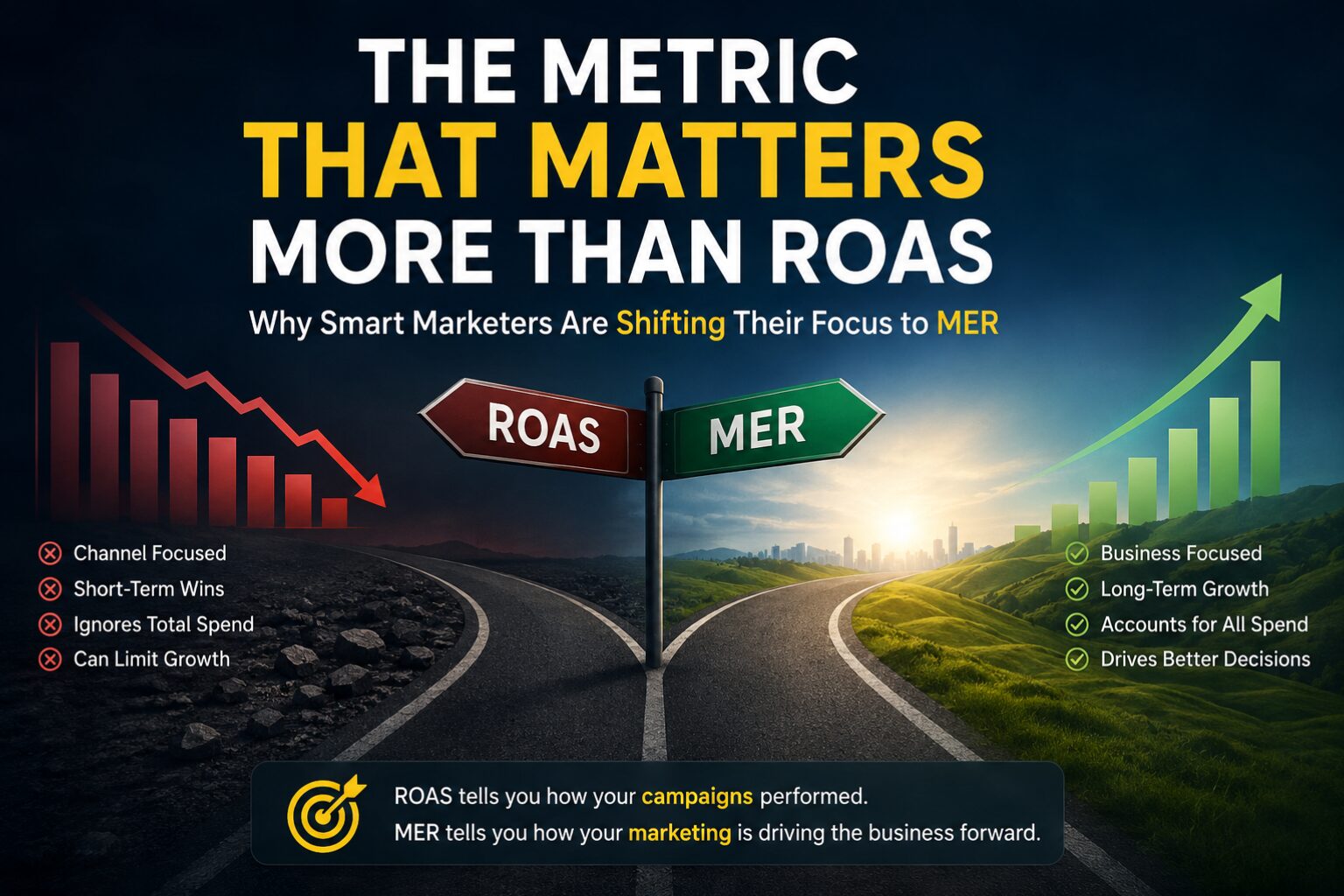
For years, ROAS (Return on Ad Spend) has been the gold standard of performance marketing.
Open almost any marketing dashboard and you’ll find ROAS front and center.
Marketing agencies use it to demonstrate results.
Media buyers use it to optimize campaigns.
Business owners use it to evaluate marketing performance.
And for good reason.
ROAS is simple, easy to understand, and provides a quick snapshot of advertising effectiveness.
But after more than a decade working in performance marketing, I’ve come to realize that many businesses have become overly focused on ROAS.
In some cases, they become so focused on improving ROAS that they unintentionally limit growth.
The reality is that while ROAS remains an important metric, it is often not the most important metric.
In fact, there is another metric that can provide a far more complete picture of marketing performance and business growth:
MER (Marketing Efficiency Ratio).
Understanding the difference between these two metrics can fundamentally change how marketers, founders, and leadership teams make growth decisions.
Why ROAS Became So Popular
The rise of digital advertising platforms such as Meta Ads and Google Ads transformed marketing measurement.
For the first time, businesses could see:
- How much they spent
- How many clicks they received
- How many conversions occurred
- How much revenue was generated
This level of transparency was revolutionary.
As a result, ROAS quickly became the primary metric marketers used to evaluate performance.
The formula is straightforward:
ROAS = Revenue Generated from Advertising ÷ Advertising Spend
If you spend $10,000 on ads and generate $50,000 in revenue, your ROAS is:
5.0 ROAS
In simple terms, every $1 spent generated $5 in revenue.
That sounds like an excellent result.
And in many situations, it is.
The problem begins when businesses assume that higher ROAS automatically means better business performance.
The Biggest Problem with ROAS
ROAS only measures the performance of a specific advertising channel or campaign.
It does not measure the performance of your entire marketing ecosystem.
Imagine a company spending:
- $20,000 on Meta Ads
- $15,000 on Google Ads
- $10,000 on SEO
- $5,000 on Email Marketing
- $8,000 on Content Marketing
The Meta campaign might generate a 7x ROAS.
Google might generate a 4x ROAS.
Email marketing may generate revenue without any measurable ROAS at all.
Looking at individual channel metrics creates a fragmented picture.
Each department may appear successful while the business as a whole struggles to grow.
This is one of the biggest challenges facing modern marketing teams.
Optimizing individual channels does not always optimize overall business performance.
The Hidden Danger of ROAS Optimization
One of the most common mistakes marketers make is treating ROAS as the ultimate objective.
When ROAS becomes the primary goal, marketers often become overly conservative.
They:
- Avoid testing new audiences
- Reduce experimentation
- Limit budget increases
- Focus heavily on remarketing
- Prioritize short-term conversions
All of these tactics can improve ROAS.
But they can also restrict growth.
Consider two scenarios.
Scenario A
- Ad Spend: $5,000
- Revenue: $40,000
- ROAS: 8.0
Scenario B
- Ad Spend: $30,000
- Revenue: $150,000
- ROAS: 5.0
Many marketers would celebrate Scenario A because the ROAS is higher.
Most CEOs would choose Scenario B because the business generates significantly more revenue.
The highest ROAS does not always produce the highest growth.
This distinction is critical.
What is MER?
MER stands for Marketing Efficiency Ratio.
Unlike ROAS, MER evaluates marketing performance across the entire business.
The formula is:
MER = Total Revenue ÷ Total Marketing Spend
The key phrase here is total marketing spend.
This includes:
- Meta Ads
- Google Ads
- SEO
- Email Marketing
- Content Marketing
- Influencer Marketing
- Agency Costs
- Creative Production
- Marketing Software
- Marketing Team Costs
Everything that contributes to customer acquisition and revenue generation.
Instead of evaluating individual campaigns, MER evaluates the efficiency of the entire growth engine.
Why MER Matters More to Leadership Teams
Most executives do not care about campaign-level metrics.
They care about questions such as:
- Is revenue growing?
- Are we acquiring customers profitably?
- Are marketing investments producing returns?
- Can we scale sustainably?
- Is customer acquisition becoming more efficient?
MER helps answer those questions.
It provides a business-level view rather than a campaign-level view.
This makes it particularly valuable for:
- CEOs
- Founders
- CMOs
- Growth Leaders
- Investors
Because ultimately, business success is measured by growth and profitability—not by the ROAS of a single campaign.
ROAS vs MER: Understanding the Difference
Think of ROAS and MER as serving different purposes.
ROAS is Tactical
ROAS helps marketers answer questions like:
- Which campaign performs best?
- Which audience should receive more budget?
- Which creative drives the highest return?
- Which keyword generates profitable conversions?
ROAS is ideal for campaign optimization.
MER is Strategic
MER helps leadership answer questions like:
- Is marketing becoming more efficient?
- Are we investing enough in growth?
- Can we afford to scale?
- Is total marketing investment producing acceptable returns?
MER is ideal for strategic decision-making.
The mistake is not using ROAS.
The mistake is relying on ROAS alone.
Why High-Growth Companies Often Accept Lower ROAS
One lesson many marketers learn as they gain experience is that scaling almost always reduces efficiency.
As advertising budgets increase:
- New audiences become more expensive
- Competition increases
- Incremental returns decline
As a result, ROAS often decreases.
This is normal.
In fact, it is often expected.
A company spending $10,000 per month may achieve a 7x ROAS.
The same company spending $100,000 per month may achieve a 4x ROAS.
However:
- Revenue may triple
- Customer acquisition may double
- Market share may increase significantly
The business becomes stronger despite lower ROAS.
This is why experienced growth leaders focus on overall efficiency rather than isolated channel metrics.
The Metrics Modern Marketers Should Track
ROAS remains valuable.
Every performance marketer should monitor it.
However, it should be viewed alongside other key metrics.
These include:
Marketing Efficiency Ratio (MER)
Measures overall marketing efficiency.
Customer Acquisition Cost (CAC)
Measures the cost required to acquire a new customer.
Customer Lifetime Value (LTV)
Measures total customer value over time.
Contribution Margin
Measures profitability after variable costs.
Revenue Growth
Measures overall business growth.
Marketing Spend as a Percentage of Revenue
Helps determine whether marketing investment levels are sustainable.
Together, these metrics provide a much clearer understanding of business performance.
When Should You Focus on ROAS?
ROAS remains extremely useful when:
- Managing paid advertising campaigns
- Optimizing creative performance
- Evaluating audience targeting
- Comparing channel performance
- Managing advertising budgets
At the campaign level, ROAS remains one of the most important metrics available.
When Should You Focus on MER?
MER becomes increasingly important when:
- Scaling marketing budgets
- Evaluating business growth
- Reporting to leadership teams
- Comparing long-term performance
- Allocating marketing resources
The larger a business becomes, the more important MER tends to be.
Final Thoughts
For many years, I viewed ROAS as the ultimate marketing metric.
Today, I see it differently.
ROAS tells us whether a campaign is working.
MER tells us whether our marketing is working.
Both metrics matter.
But if the goal is sustainable growth, profitable customer acquisition, and better strategic decision-making, MER provides a much more complete picture.
The best marketers don’t choose between ROAS and MER.
They use both.
They use ROAS to optimize campaigns.
And they use MER to guide growth.
Because in the end, marketing is not about producing impressive dashboards.
It’s about building a business that grows.

Khurram Zahid is the founder of Kay Zee Consulting, a B2B performance marketing agency serving companies in Pakistan, Saudi Arabia, UAE, and across the Middle East. With 15+ years of experience in B2B demand generation, PPC, and SEO, he has helped companies scale from zero to 1,500+ qualified leads per month and achieve 10x ROAS on advertising budgets. He specialises in building the marketing systems that create predictable, measurable pipeline for B2B startups and SMEs.